 by
by Nes Harim is a quiet bedroom community outside of Jerusalem that has an unexpected past. It was founded by Moroccan and Kurdish Jews shortly after the declaration of the state of Israel in 1950 when Jews fled these countries as a result of the establishment of a Jewish state. Its neighbor, Bar Giora, was also founded at that time by the same population.
Why would a government run by European, Ashkenazi Jews give such prime real estate – nestled in the lush Jerusalem hills and overlooking the main Jerusalem to Tel Aviv highway – to poor, Sefardic refugees?
Most well-known stories of Jews coming as refugees from Arabic speaking countries in the years following Israel’s independence start in strong Jewish communities, most spanning hundreds or even thousands of years thriving all over the Arabic-speaking world. After Israel declared independence, their countries’ governments made life increasingly difficult for their Jewish population, sometimes even forcibly expelling them. What united these Sefardic refugees was their yearning for Jerusalem and their hope of a better life after being exiled by countries such as Morocco, Libya, Tunisia, Egypt, Algeria, Syria, Iraq and others. These Jews looked very different from the Ashkenazi Jews who controlled most of the agencies and government – the Jews who had dominated immigration from 1882-1948. The Sefardi Jews often came with no resources as refugees, with only the shirts on their backs, because their respective countries did not allow them to take any of their wealth with them.
When they arrived they were loaded into trucks in the middle of the night and driven to the Negev – to tent camps that would become Sederot, Netivot, and Dimona.
Those are the unfortunate normal stories.
But if we go back to 1948, David Ben-Gurion, Israel’s first prime minister, had to almost immediately begin dealing with the issues of refugees. Besides being a humanitarian issue, settling people is also used as a boost to security. Settled lands are more difficult to conquer than empty land. The refugees, who had little say in where they were going to be living in Israel, were given a safe haven, but also used as tools for the nascent government trying to provide security.
One of the first groups to come was taken to settle Nes Harim. The name derives from Isaiah 18:3 and means “a banner on the mountains” – fitting the physical landscape. The choice of location for this group of Jews from Morocco and Kurdistan was a security measure. At the end of the Independence War, Jerusalem was surrounded by the Jordanians, with Israel only retaining control of West Jerusalem and a thin corridor on either side of today’s Rt. 1 connecting Jerusalem to Tel Aviv. Back then, the mountains on either side of the highway were just as dangerous and exposed as any border territory. The desire to protect the highway with population – any Jewish population – drove Ben Gurion to settle those with few choices in these dangerous border areas.
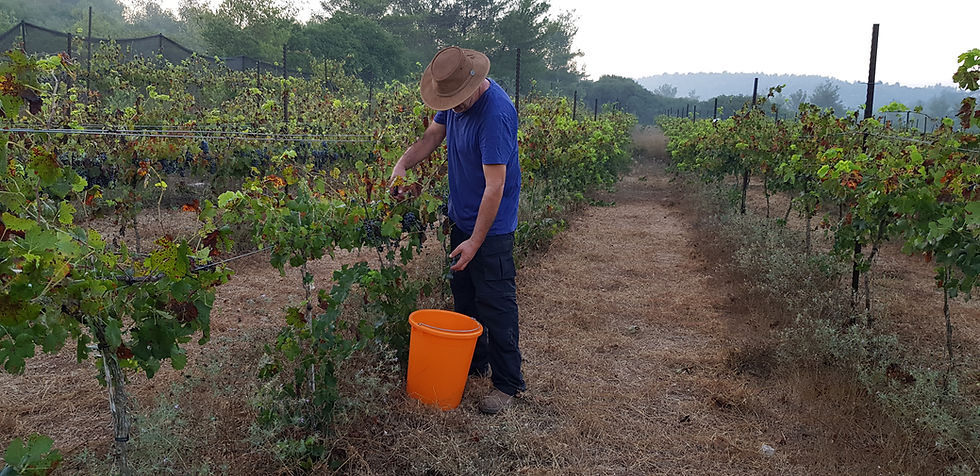
As time went on and the number of Jewish refugees from Arabic speaking countries surges into the hundreds of thousands, more space is needed for them and Ben Gurion sees an opportunity to strengthen the Negev, an area which he considered very important for the development and the safety of Israel. The founder of Katlav winery, which is located in Nes Harim, tells of his family’s journey from Morocco. They were not one of the first to come to Israel. They were promised to be settled close to Jerusalem, as was their dream and where their family from Morocco had settled beforehand. In the middle of the night, however, his family were taken from the port, loaded into the back of a pick up truck, and taken to the Negev. Upon arriving at the tent city that would become Dimona, the truck driver told them, “Get out!” but they refused. This sandy place was certainly not Jerusalem. They didn’t budge. “Take us to Jerusalem!” The poor truck driver had no patience to fight with this family in the middle of the night in the middle of the desert. So, he simply turned around and went back to the port. Eventually the Yttach family made their way to Nes Harim. By the way, the wine from Katlav winery is top-notch. When you go, say “hi” to Yossi for me.
At its founding, Nes Harim was organized as a moshav – a co-op – that had chicken coops and orchards. Today, the chicken coops have closed, although there are still some dairy farms. Most people from Nes Harim work outside of the moshav, and its excellent location overlooking the highway between Jerusalem and Tel Aviv makes it a desirable country location for those working in the cities.
 Israel by Leiah
Leave a comment