 by
by When I was choosing a place for the last night of this Hanukkah series, there were a few options with “Kedem”. I asked my oldest son which place sounded the most balanced for this series, which is meant to span the entire land of Israel with places from the phrase: “Nes Gadol Haya Po”. We’ve already been to the Golan Heights, the Western Galilee, the Shomron, Central Israel, the Jerusalem hills, the Dead Sea, and the Negev. I mentioned Pnei Kedem in the Hebron Hills as an option, and my son said, “That’s a beautiful place.” He was there with the army, and I think it a testament that even during his army service he was able to see the natural beauty around him.
Pnei Kedem sits over the Nahal Arugot streambed, which flows to the east and empties into the Dead sea. For this reason, the town took the name “Pnei Kedem” meaning facing east. Its location is impressive, sitting at an elevation of 930 m (over 3000 ft) above sea level, views of the mountains of Moab to the east in Jordan are visible on a daily basis. Its height has even afforded an occasional view of Mt. Hermon, to the north, a distance of 220 km (140 miles), underlining Israel’s small size.
It was established in 1994 on the outskirts of Metzad as a school for kids who were not succeeding in traditional educational settings. The school survived for 6 years until it was closed in the summer of 2000. That same summer, the first families of Pnei Kedem, just 3 families and 3 single people, came in the middle of the night to establish the community. Reminiscent of the founding of the 11 points in the Negev in 1946, or the erection of the Tower and Stockade settlements mostly in northern Israel between 1936-1939, these pioneers established the town and built rudimentary structures in one night.
From this time forward, the community has grown as more families looking for a slower life moved in. In time, orchards were planted with olives and grapes, and a farm established. In 2016, Pnei Kedem opened a students’ village, to attract young people to live and contribute to the town. They run after school programs, volunteer in the farm, and take an active part in communal life. Throughout the years, there have been scuffles with the surrounding Palestinian population, with both sides charging the other of uprooting trees from their orchards. Despite the challenges, however, the wide open spaces, the country life, the family-like community spirit, and the feeling of building in the land of their forefathers strengthens this community and contributes to its growth.
The town is part of the Gush Etzion regional council and was recognized by the Israeli government in 2003, albeit as a neighborhood of Metzad since it was built on land within the boundaries of Metzad. Only in 2020 did the status of the community upgrade into an official independent town.
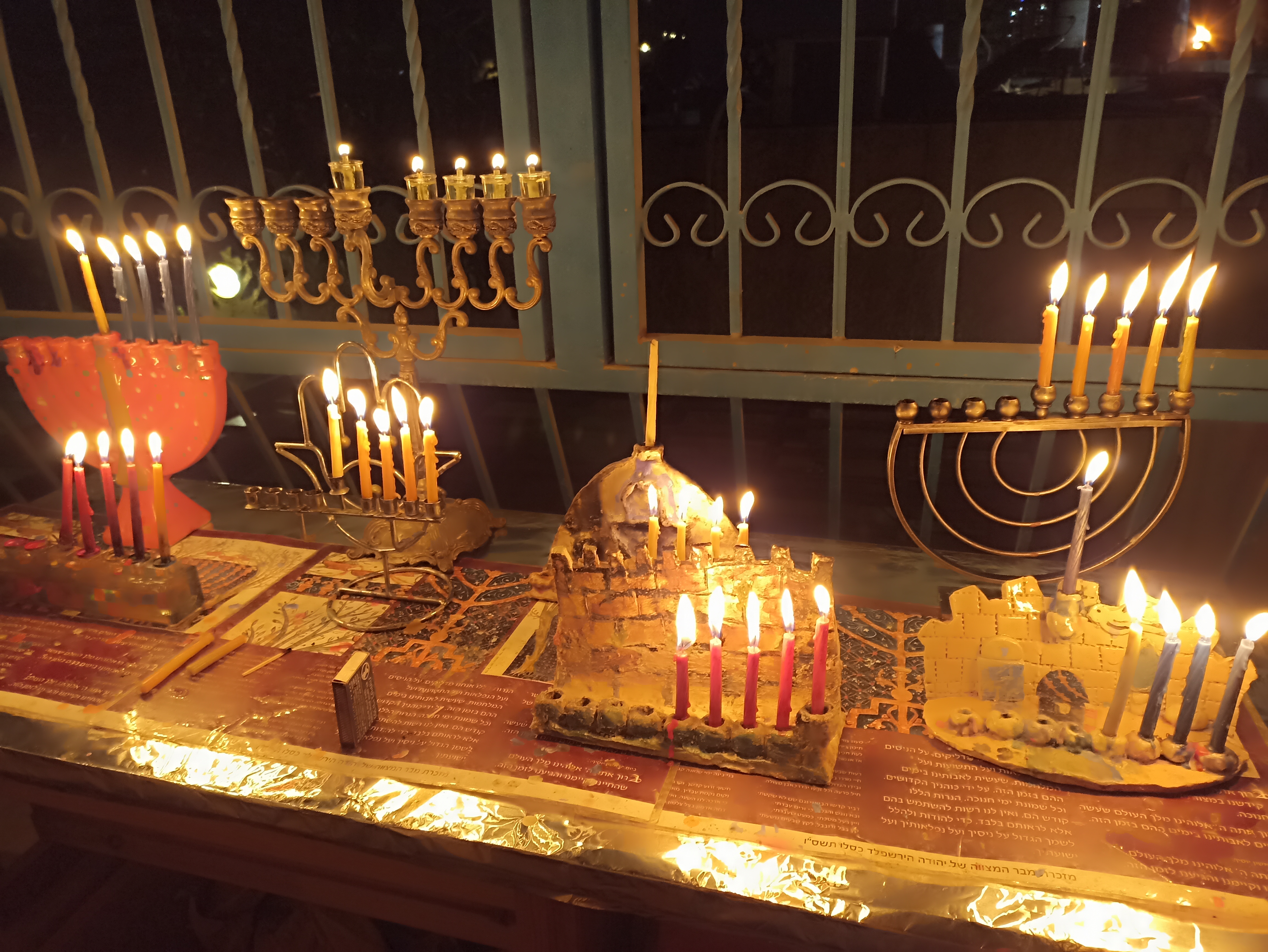
There it is! Hanukkah Series 2024! Ending with Pnei Kedem, building strong communities in the land of Israel, is really the culmination of the series. These communities, the idea that we are all one family, and our shared core values are really, in essence, the “nes gadol haya po”.
From north to south, cities and small towns, natural wonders of all types, I’ve highlighted some interesting places and communities in Israel. They are the real miracle that not only happened in the past, but continues to illuminate our present, and light the way to the future! Hanukkah Sameach!


This is obviously a strategic place. Oh, how I wish that all of the People of Israel WOULD see us as one people, regardless of where we live in Israel. Even after October 7th, there are too many people who make the distinction between living within the Green Line or over the Green Line. Thank you for an informative post. I will read the others.