 by
by There aren’t any places I could find in Israel that contain the word “haya”, so instead I decided to look at the past tense, and go with the word in the Bible used many times to denote the past – “kedem”. “Kedem” has an additional meaning as East, because this is the first part of the daytime, and thus the part of the day that first becomes history. The “days of yore” in Biblical Hebrew are called “yemei kedem”.
Our first “kedem” locality is a streambed – Nahal Kedem. Nahal Kedem and the Kedem falls are located in the area of the Dead Sea. Starting in the Judean desert, Nahal Kedem gathers the scant rainfall that falls and directs it towards the east and the Dead Sea basin. After it has made its way through the desert, it ends in a cliff 300 m (almost 1000 ft) overlooking the Dead Sea. There, it cascades over the cliff and forms a waterfall – the highest waterfall in Israel. This waterfall is fleeting. It is only active in the winter when there is a good storm. During the rest of the year, it is bone dry. Designating a geological formation as a nahal just means that there is the potential for water, and not necessarily that there is water continuously. Today, December 31, 2024, Nahal Kedem flowed, and the Kedem waterfall cascaded over the cliffs above the Dead Sea.
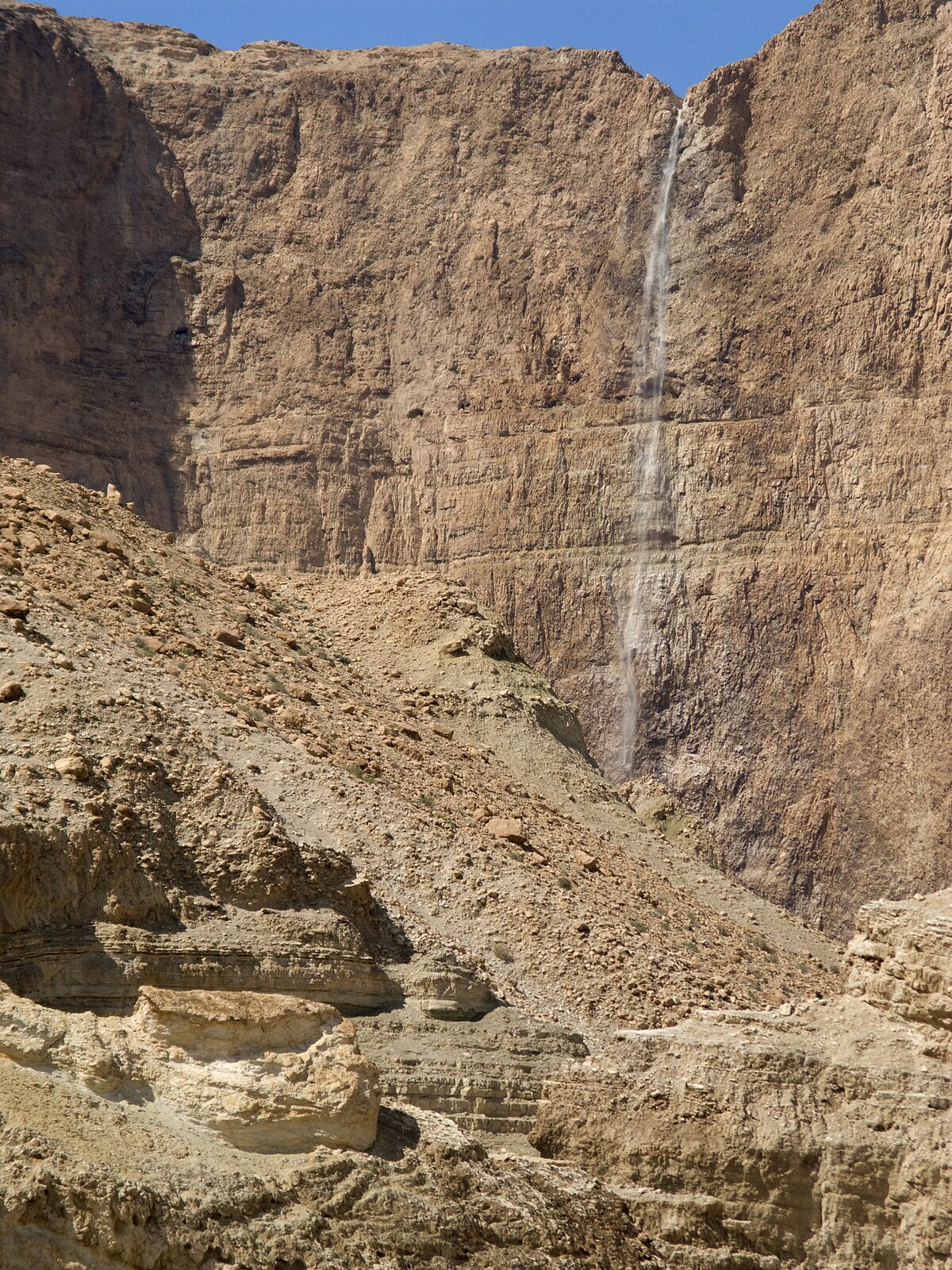
In the Nahal Kedem streambed are found some interesting trees. The first is an Atlantic Pistachio tree – one of only 2 in the entire Judean desert. And even rarer, at the top of the waterfall is a fig tree – the only one in the Judean desert. One wonders how the fig got there, whether it was a remnant of a wetter time or if it was swept away in scat from a desert mammal. In this arid landscape, the appearance of large trees such as these is even rarer than the appearance of water.
The other feature that Nahal Kedem is known for occurs just as the streambed meets the Dead Sea. A series of natural hot springs near the shoreline create nature’s hot tubs. These sulfurous pools are a favorite for hikers and adventure seekers. Walking to the Dead Sea shore in this area is a bit treacherous. There is no road, no marked path, and no fresh water. Instead, you need to tip-toe around sink holes and quicksand to arrive at these unique pools. Make sure to bring fresh water with you as the hot springs’ water contains a lot of minerals that can sting if not rinsed off after you enjoy your dip.
Waterfalls, solitary trees, and hot springs make the area of Nahal Kedem, truly a miraculous place, full of desolation and greenery, fresh water and sulfur springs, high cliffs and sinkholes. A place that connects us to nature and showcases the power of the natural world.
 Israel by Leiah
Leave a comment